Showing posts with label rock climbing. Show all posts

Friday, August 8, 2014

Training for the Red on a 7 foot bouldering wall


A 5 min ARC training lap in the dojo. 
[please mute / ignore the audio]

I am training for the Red River Gorge on a very short bouldering wall.  At the tallest, the ceiling is between 5 and 7.5 feet.  What the wall lacks in height it makes up for with options for traversing.

Starting in August I have been climbing 3 days a week, and after this weekend (my 6th training day) I will have accumulated about 500 min on the wall.  After that I will have 4 more training days of endurance before I switch to strength training on the hangboard.

When training endurance or "base fitness" I normally stay on the wall for sets that last about 15 to 35 minutes, and rack up a total of 80 min per training day.  That is about all that my skin can handle with the heat and humidity of the South East Ohio summer.

The lap in the video illustrates one of the least steep routes through the room and takes advantage of rests where the ceiling is high enough to actually stand up.  Other times I do laps with big moves from big holds to work full body strength.  However, I already have good endurance on big holds and want to improve my endurance on smaller holds and less steep angles.  So I am trying to spend more time grabbing smaller holds, and resting on holds that are less than full hand jugs.

The Rock Climber's Training Manual advocates for endurance training on wall angles ranging between vertical and 30 degrees but I don't really have much terrain for that.  Hopefully, creative use of rests and using smaller holds than I had used in the past (i.e avoiding most of the jugs and using more 1st and 2nd pad holds) will offset the "too steep" limitation and help me complete some tall endurance routes at the Red this fall.


Friday, May 16, 2014

How training can spur greater improvement.


How to read this graph:   The four rectangular shapes represent the four types of training / fitness combinations directly related to forearm fitness described by the Anderson brothers in RCTM.

ARC/MSS (moves: 60 to 700; intensity: 10% to 40%) this training involves large numbers of consecutive moves at low to moderate effort levels, and requires climbers to manage their level of pump by controlling their activity and resting behaviors.  Seldom will performance oriented climbing days include these combinations of moderate intensity with extremely long duration, which defines the activity and spurs maximum endurance fitness growth.

Power endurance (moves: 12 to 30; intensity 60% to 90%, duty cycle 1 min effort to 2 min rest) workouts are can include 6 sets of 20-26 hand moves, at intensity high enough to prevent resting, organized in rapid 1 min on / 2 min off duty cycles.  While power endurance challenges are encountered in the context of climbing, they are not repeated sufficiently, nor are they organized into a series of duty cycles with only two min of rest between each 1 min of activity.  Thus the adaptive response is limited as climbers instead seek to maximize their chances of success on a particular route.

Finger strength (moves: 3 to 7, intensity 55% to 80%)  is best cultivated through hangboard workouts, organized around grip type, and with multiple sets of brief repetitions (7 seconds) separated by briefer (3 second) rests.   These workouts allow climbers to reach muscular fatigue for particular grip types in 5-7 reps, which maximizes adaptive response while minimizing risk of injury, unlike in route situations in which randomly encountering a grip type may be in a single repetition and near the climbers limit.

Limit bouldering and campusing (moves 1 to 5; intensity 80% to 100%) are the best ways to cultivate power, which is instantaneous application of finger strength.  This is best trained on comfortable consistent grip types over a short range of 1 to 5 moves.

There are at least three reasons that systematic training can spur greater amounts of adaptive fitness response than simply bouldering and climbing for fun.

  1. Routes are too arbitrary. Arbitrary selections of holds, intensities, moves, and durations do not inspire as strong of an adaptive response from the forearm muscles.  
    1. Most routes include a wide range of hold types, intensities, and durations.  This reduces the chance for systematic fatigue in any one set of forearm muscles.  
    2. Route challenges will seldom match climbers specific training level needs.   The four different dimensions of forearm fitness are responses to different types of climbing challenges, and for any climber, these will require particular combinations of hold intensity, duration, and variety.  Most outdoor routes and problems are just too idiosyncratic to be effective training vehicles for general fitness goals (though parts of routes can be selected for fitness training).
      1. It is possible to use outdoor routes as training resources, but most climbers tend to treat all outdoor routes as performance tests, rather than as a means to cultivating particular types of fitness (see 3 below). 
  2. Routes are too limited in any one dimension.  Systematic training includes combinations of durations, intensities and hold types that are more extreme and are intentionally specific to types of climbing fitnesses. 
    1. Hangboard workouts focus effort on repeated, controlled loadings of the exact same muscles until those muscles fatigue to failure.  Routes will seldom have repeated grip types to specifically fatigue forearm muscles to failure in a systematic, progressive way.   
    2. Power-endurance workouts are tailored to generate and sustain intense forearm pump thought a series of numbered moves, and are repeated before full recovery is made.  Bouldering for fun would remain more performance than training oriented.  
    3. ARC sessions are much longer duration than most climbers encounter in ordinary route and problem completing situations.
  3. Climbing for fun is too focused on performance over process.  Climbers who only climb for fun tend to focus on their strengths and leave gaps in their training procedures, such that certain types of fitness are insufficiently cultivated.   
    1. Fear of failure or pressure to complete routes can inspire climbers to risk injury or keep them from attempting routes that may actually provide the best workout.   Others may continually get on routes that are too difficult, only to spend most of their climbing time hanging at the next quick draw.
    2. Everyday climbing can encourage climbers to stay in the comfortable middle ground of challenge.  For instance, it is easy to meet climbers who have been climbing for fun, but have never put in a session of ARC climbing with more than 100 moves in a row.  Correspondingly, these climbers are unable to rest and recover effectively on routes.   
    3. Other climbers might climb in extremely static styles, and will have insufficient power and lack the neuromuscular habits of efficient deadpointing, and "go-for-it-ness" that they use in campusing or limit bouldering.

Tuesday, May 13, 2014

A foundation for ongoing improvement


The Rock Climber's Training Manual shipped in early April.  I had decided to pre-order it, based on the valuable insights that the Anderson brothers had already shared on their blog.  I find it to be the most important climbing training publication since "Performance Rock Climbing"  because it expands and extends principles of improvement and periodization of climbing training to maximize performance.

Most crucially, as a parent with a busy work schedule, I am glad for the patient and long term perspective that it advocates and the fact that the authors themselves are middle aged climbers who manage to balance careers, families and a dedicated training and climbing system.  Reading the chapters has also helped me identify my priorities in terms of climbing goals and ways to organize my training, practicing, and climbing time.  I wish I would have had access to this book when I was younger, but, I am am glad that at least I can benefit now.

If I were to oversimplify, here are several big picture principles I draw from this book:

  1. Articulate what you want to enjoy from climbing and how you want to improve in order to enjoy those dimensions more:  Personally I am most motivated to improve at my capacity to climb gymnastic, overhanging sport routes.  I want to be able to travel to crags and enjoy the best of the gymnastic sport routes that I can find, and especially, to be able to enjoy the world class gymnastic routes at local areas like the Red and New.  
  2. Identify concrete short term and long term goals:  I articulate my goals elsewhere, but the Anderson brothers are correct to emphasize that working towards specific goal routes is much more motivating and valuable than simply working to improve or to climb a certain grade.   Apollo Reed is a brilliant route, and if you are inspired to climb it, you can quickly deduce how you need to become stronger and wiser in your climbing.
  3. Tailor your training and practice towards achieving your goals, given your current capacities and weaknesses:   Currently, my limiting factors are endurance and power endurance.  Once I know that, I can work to elevate all of my performance areas, but concentrate extra attention on climbing medium intensity for long time periods (20 to 40 minutes) and high intensity for 20 to 30 hand movements with no rest.  
  4. Be patient:   You will need at least a minimal level of patience if you divide your year into three climbing seasons, and specify the last month of each season as your time to focus on performance on outdoor routes.  If you also recognize that slow steady improvement is the only type of sustainable progress then you will not be in a rush to "climb harder".  Instead you see that improving is one of the great joys of any athletic pursuit, then you need to savor and enjoy the moments of progress.  The joy is in the journey, not the end result.  
  5. Progress results from training when focused, consistent, and progressive.  Therefore, careful documentation of both objective dimensions, and subjective experience are key to making continual, incremental adaptations to the demands of training.  A good dose of bureaucratic record keeping and self monitoring go a long ways towards both motivating effort and achieving progress.  
  6. Take time to cultivate all four of the relevant dimensions of fitness for the forearms/fingers.  Ultimately, the limiting factor for most climbers and climbing is defined by capacities in endurance, strength, power, and power endurance of their fingers / forearms.  The body increases capacities in these dimensions by responding to particular combinations of effort, duration, and rest.  Reflecting carefully on how you currently climb / train, will help show you what is missing.   

In addition to finger strength, other areas of strength need to be developed, and technique needs to be refined and practiced, but these can be integrated into the larger program of developing those forearm capacities. A good fitness plan for climbing addresses 6 key areas:

General bodyweight fitness and flexibility:  climbing involves moving and supporting the body through three dimensional spaces.  Secondary and antagonistic (relative to primary climbing related) muscles of the body should be trained to some minimal level of fitness to support this and to add general athletic capacity.   These can be accomplished either through weights, or better yet, through body weight exercises, including progressions related to:  pushups, dips, L-sits, handstands, and some integrated lower body work like squats (in the lower body especially, strength without hypertrophy is advantageous for climbers).   Flexibility work with yoga, stretching, and foam rolling are key especially for older climbers.  All of these can be pursued on rest days from climbing / training.

Climbing specific bodyweight fitness:   climbing is mostly about pulling your core up and in.  Increasing strength at progressions related to pull ups, inverted rows, and core strength progressions like hanging leg lifts, front levers, and plank are key.  Depending on the climbing related trainings, these can be added to more climbing specific work.

Finger / Forearm ARC/MSS Endurance Or, in words, Aerobic Recovery and Capilarity / Maximum Steady State describe fitness related to the capacity to exert low to moderate levels of effort with the forearms for extended periods of time.  The maximum steady state is the highest level of exertion that a climber can perform without reaching a state of overexertion that requires temporary cessation of effort.  This type of endurance is trained climbing a level immediately at the MSS for long durations of time.  An ARC session might include two to four repetition of 20-35 min periods of constant climbing, where the climber works to maintain/ manage a mild forearm pump.  These long sessions can be integrated with skill work that focuses on small footholds, body tension, finding rest positions, pacing, etc.

Finger strength refers to the amount of weight each hand can support from a given type of hold, and is thus highly specific to hold type and angle of loading.   Performing dead hangs from a fingerboard is the safest and most predictable method for increasing finger strength.   Finger strength defines the upper bound of power that a climber can cultivate, and in general, finger strength should be cultivated earlier in a training cycle than power.  However, since muscle increases strength more rapidly than connective tissue, this strength should be cultivated slowly and should allow sufficient periods of rest where maximum strength is not cultivated.

Finger power is the immediate application of maximum finger strength.  Whatever strength has been cultivated can be tailored towards greater power by encouraging the body to stimulate growth and activation of more of the fast twitch muscle fibers.  Power is enhanced by training brief intense loadings, through either limit bouldering or campusing.  Limit bouldering involves problems of 1, 2 or 3 hand moves that are maximally difficult.  Campusing for power involves 1 to 5 hand movements at maximal difficulty.   Great care should be taken in power training to avoid injury and overtraining.

Finger power-endurance refers to the capacity of the body to sustain high levels of effort for medium numbers repetitions, for instance, the crux section of a route may be composed of 20 moves of near constant difficulty that does not allow resting or shaking out.  Power endurance is produced by short term adaptations of the body to increase the amount of recovery enabling enzymes in the trained muscles.  Thus power endurance should be the attribute that is trained in earnest immediately prior to the performance phase.  Power endurance is trained by performing 20 to 30 high intensity movement sets, with brief rest periods between repetitions.  For instance, develop a 25 move boulder problem where every move demands an effort of 80% or so, or is intense enough that resting / shaking out is not possible.  Repeat that problem 6 times with just 2 min of rest between each repetition.  


Periodization of training cycles.   You can't train all of these things at once.  But thankfully, they can be cultivated in turn, during different training periods.   Each of these time periods can include climbing for fun or training outdoors as well, but the available training time for climbing should be focused on the types of workouts that cultivate that dimension of climbing fitness.   Here is an example 16 week season.

Week 1    Rest.
Week 2    ARC/MSS     (2-3 bodyweight sessions can be integrated throughout each period)
Week 3    ARC/MSS
Week 4    ARC/MSS  + Finger strength
Week 5    Finger strength
Week 6    Finger strength
Week 7    Power
Week 8    Power
Week 9    Power
Week 10  Power endurance
Week 11  Power endurance
Week 12  PE / Performance
Week 13  Performance
Week 14  Performance
Week 15  Performance
Week 16  Performance


Friday, December 3, 2010

Open hand training holds

1.  Finger bucket for 30 degree and steeper walls.


2. Wider version of same design, placed on roof section.
While reaching up and out from the 30 degree wall below
this type of hold makes a challenging open-hand match.

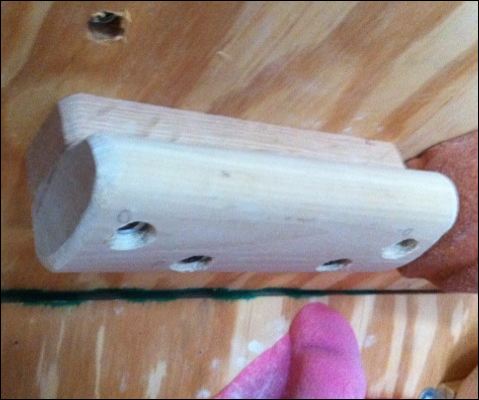
3.  Same design, but made with round hand rail for 'slabbier' walls.
Rail is flush with backing to make deeper,
comfortable open-hand edge.

4.  Open hand training hold, with thin rail. 
This design uses a pine 2X3, with one corner ripped off;
plus a thin oak molding.

5.  I made about 10 of these open hand trainers to create 
a mini system wall in the kids area of the dojo.


All of these holds are basic edges that are intended to be installed semi-permanently at particular angles, and with one face up.  This is a good solution for home walls because such simple designs are easier and faster to make than general purpose holds, and they can fill in space around the bolt on holds.  While basic edges are "boring" they are the most common type of hold, especially on sandstone, and are a great resource for training.

The last type of the training hold [image 4. above] brings up a couple of general points about hold layout.   In a home wall, you should create spaces that allow you to train in different ways.  The last image shows a small section of slightly overhanging wall above a small angled roof.   This a great place to work on hanging slopers, but thin edges are hard to use here because holds immediately underneath can obstruct access the thin edge or impinge on your forearm.

Placing the thin edge on the face of the sloper means that you can still access the thin edge even with a more bulky hold immediately below it.  Plus, an array of these training holds let you practice similar movements from both sloping and thin open-hand edges.

Monday, October 26, 2009

East side of Copperhead Ridge: The Emerald

This gem of a freestanding boulder is located on the eastern side of Copperhead Ridge. Starting from the Cucumbertree Connector, hike westward on the Rockhouse trail, towards Copperhead Ridge and the COAD boulders. About 1200 feet past the wooden footbridge you will begin to see boulders up on the ridge. Soon after that, there is a small clearing on the left side of the trail with a 7 foot tall boulder with a triangular face. Turn left, walk away from the main trail, through the clearing, the Emerald is just out of sight, down the hill.

There are several interesting and challenging lines on the Emerald. Problems ascend dishes and pleasently rounded sidepulls on the green slab, next is a mostly blank gray face with a low, intermittent rail crossing it, and the overhanging back of the boulder includes a couple of short overhanging problems. Inspect the down-climb and the top-outs for fallen leaves before attempting the higher slab routes. Mantle finishes guard your escape. Punting off mid-mantle is not recommended.

The back of the Emerald sports a couple of the better (V3-5) problems in Athens County, characterized by decent quality stone with interesting holds and movement. However, because of the fragility of the local sandstone and the mantle topouts the Emerald is best saved until after a good dry spell. A couple scars indicate holds have broken, but prudent climbers can easily enjoy the problems while preserving the best features.

The slab has at least three lines, increasing in difficulty from left to right. The left arete of the slab has potential for an easy route as the leaves and vines reveal some pleasant rounded holds.

The gray face probably has a line that cranks off the left hand side pull / undercling all the way to the fragile looking chicken heads. It looks awkward but doable.

The steep side has two distinct lines, the "Emerald Arete" that ascends the pictured prow with pockets, pinches and edges. The second problem cranks off a sidepull horn to a matching pinch, then slaps the rounded lip. Boost the difficulty of the arete by off-routing the two pockets.

A fun moderate (V1-ish) lowball is possible by starting at the far right end of the rail, and traversing left until it peters out and you can establish your feet on the detached rock under the left edge of the gray face (i.e. no topout). Contrived but fun.