Monday, September 19, 2016

Cool things are afoot in Athens!


comingsoon.PNG


Coming soon to Athens Ohio!   (but only if you get involved and help make it happen)
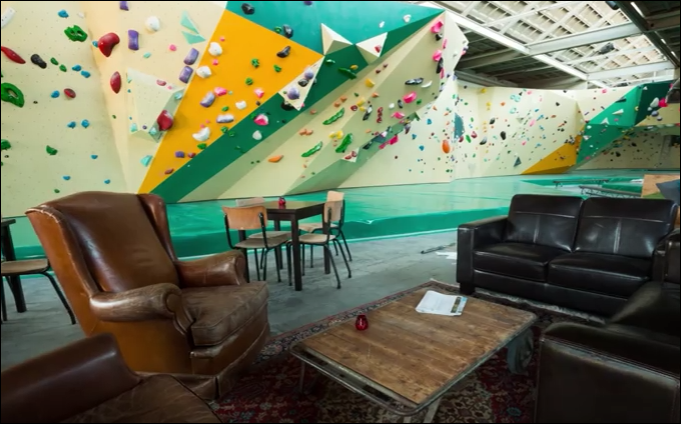
Climbers living in Athens, Ohio have long dreamed of having a great climbing resource in town (like this new bouldering gym in Leiden, Germany).  But the unfortunate reality is that these amazing modern bouldering gyms are usually the product of investors who see a great money making opportunity.  Athens is too small of a market for that.   
However, there is a different model, one based on the community getting together to pool resources and build a great gym that is for the community and provided by the community.  The best example is the Slo-Op in San Luis Obispo, California.  This gym grew from a home bouldering wall located in a storage facility into two locations with hundreds of members.  See the Slo Op page.
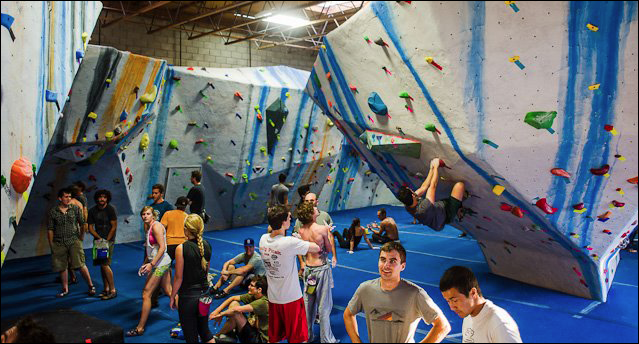
To make the Slo Op happen they focused on building community, leveraging the resources that they already had, and organizing as a non-profit social club.  That is what we at Climb Athens are doing now for Athens, but to do that, we need your help.  

Become a member of the community and support the effort.
  1. Climbers and parents of young climbers who live in and around Athens, Ohio.  Join Climb Athens ($20 lifetime membership) and pay for an access pass to boulder at The Dojo and Beta Fish for the next 9 months.  The membership and access pass will allow you to participate in Climb Athens events and help build our supportive and vibrant climbing community.  Climb Athens plans for a regular schedule of 2 nights per location each week.  A limited number of access passes are available for Fall 2016.  We are seeking 20-25 student members ($100 access pass) and 20-25 adult members ($150 access pass).
  2. Athens Climbers in exodus who have dispersed around the globe!  Support Climb Athens with an Alumni membership including: a lifetime membership so you can come back and climb some day, two day passes, a swank Climb Athens t-shirt, and the opportunity to participate in the planning and discussion online in the Climb Athens Facebook Group.  The Alumni Access pass costs $50.
  3. Community investors who can contribute to building more healthy and fun options for recreation in Athens Ohio.  Contact Ted and Bryant about our money raising goals, business plan and our opportunities/limitations as a non-profit social club.  In short, our money can come solely from membership fees and non-interest bearing personal loans.  The only profit from this venture will be the increase in the quality of life Climb Athens can bring to our little corner of the world.      


About us:    
Climb Athens is a community based non profit climbing company.  It was founded in September of 2016 by Ted Welser and Bryant Noble.  We are running Climb Athens as a nonprofit social club acting under the provisions of the 501(c)(7) federal tax code.  This designation means that at least 85% of our operating budget must come from members (dues and access fees) and that our programs must serve the interests of those members rather than provide profit for investors or anyone else.  This strategy makes Climb Athens a type of “community sourcing” organization that exists because of the contributions of members, for the benefit of those members.  
Our Mission:
  1. Build a supportive, cooperative learning community for climbers of all levels to develop their skills and character.
  2. Establish high quality, accessible, and inspiring climbing facilities in Athens Ohio.
  3. Organize events for members to socialize and participate in the activities of bouldering, climbing, training, and recreation related to climbing and bouldering.
  4. Encourage healthy, lifelong active lifestyles through bouldering and climbing.
  5. Advocate for climbing and a healthy, active lifestyle locally across Athens County, and more broadly across the Appalachian region.
  6. Such other purposes and activities as are both lawful and in accord with the above stated General Purposes.


Our plan for growth:
Phase 1: Build core membership.   In Autumn 2016 we aim to build a core of dedicated members, formally establish the organization with LLC and 501c7 status, and purchase gymnastic mats and climbing holds.  Because Climb Athens does not yet have a climbing facility, we will work cooperatively with community members to provide benefits to members.  This includes arranging regular access to existing home bouldering walls, taking local bouldering tours, and offering skill and training workshops.     
We estimate that we will need 40 to 50 local members who have also paid the 9 month access fee for fall 2016 through Spring 2017.  If we reach our goal of 40 active members then we will be able to offer 2 regular weekly climbing events at The Dojo and two at Beta Fish, in addition to special events like bouldering tours and competitions.  
Phase 1 resources: Climb Athens is utilizing two home bouldering walls as climbing resources during our initial phase of organization.  
The Dojo is a garage attic bouldering gym with steep walls, low ceilings, 425 square feet of climbing surface, and about 1500 climbing holds.  There are about 90 different marked boulder problems ranging from V0 to V10.  The Dojo also has two hang boards and a campus board.  
Beta Fish is in the corner of a very large garage with a 12ft tall ceiling.  The main walls include an 8ft wide 40 degree wall with overhanging aretes, a 20 degree wall, and a couple dihedrals.  The 40 degree wall includes a Moon / Kilter hybrid board allowing for both extremely difficult problems and easier juggy ones too.  Beta Fish also has two hangboards.  
Phase 2: Build a bouldering gym.  In Summer of 2017 we plan to rent a commercial space and build a bouldering gym in Athens Ohio.  We will fund the startup costs primarily from pre-sale of annual passes and personal loans from community members who want to support active and healthy lifestyle options in Athens Ohio.  During Phase 2 we will expand our membership, greatly extend the hours of availability for the Climb Athens gym and expand the instructional programs to include a youth climbing club.  
 
Join Climb Athens

Wednesday, August 3, 2016

Fall 2016 Training Plans


Link for those who want to copy format of the google sheet.

I am finishing up a mini-season of strength training, and then I will go into a week of rest from climbing until my Autumn season officially starts on August 13th.

I am planning for a climbing season starting at the end of September, peaking in November and concluding before Thanksgiving.  Hopefully we will have plenty of crisp Autumn days before the snow falls.

I made great progress this summer, which added onto my spring progress on the hangboard.


Saturday, July 23, 2016

Building a Moon^Kilter Hybrid Board

This was our Moon^Kilter hybrid board before the 55 Kilter holds arrived.  
(showing an old set up Ben Moon #4, A and B)  

Moonboards are awesome, and the online problem set is super fun and motivating.  The app is a great way to share problems, and we really enjoy trying problems from folks around the world.  However, Moonboards have four major shortcomings which the Moon^Kilter Hybrid Board solves.
  1. The T-Nut Grid is too sparse.  
  2. The hold types are limited in style and size
  3. There are no easy problems (V4 and harder only)
  4. Moonboards are good for training power, but not for warming up, PE or endurance work.
Our hope is that our Moon^Kilter Hybrid can become a prototype that encourages Moon and Kilter to team up to create a board with an expanded grid, with more varied holds, and a wider range of problems.  This will greatly expand the range of climbers who can enjoy the board, and the ways they can train on the board.


Solution #1:  The Moon^Kilter Hybrid adds 180 more t-nuts, centered in 12 columns, and 15 rows.  You can see the holes centered in the moon grid here (pencil lines).


(Arrows mark the additional 5 rows per sheet across 12 columns)


Solution #2:  The Hybrid adds awesome holds from Kilter that extend the variety of hold types without blocking access to other holds on the board.


Here are the 7 Kilter sets that we added in the blue "easy" group: 

(Top Left) Noah Small 5              Winter XL 1 (Right)
  Rounded Crimps;                             Slugs

 Noah Large 5- Overjugs,               Winter Large 5- Jugs

Noah Medium 17- Mini Jugs,      Winter Small 9 Two pad incuts 

                            (Bottom Right) Teagan Medium 1- Mini Jugs

We are planning another group of sets in red for the "medium" difficulty.   We will move the Noah Small 5 to the red medium group, and add another set each of Winter XL 1 and Winter Large 5 to the blue group. We plan to order the sets for the red group this fall.


Solution #3:   Create easier problems, with different types of holds and movements.  Here is a photo of a climber on a V1 problem with any feet.    Eventually it would be cool to be able to include the additional holds and problems into the app with options for foothold restrictions, wider grade range and problem types.


Solution #4:   The Moon/Kilter Hybrid board is much better than the standard Moonboard for training.  We can do all of the power problems we want using the standard Moon problems, but we can add in power problems with slopers, rounded edges and small incuts and pinches.  But we can also warm up on comfortable jug hauls, develop power endurance cycles, or hop on the board for 50 move endurance rigs.  We can practice giant cranks from juggy underclings, and latch slopey dynos on smooth jugs.


Current moon / kilter hybrid set up using the 2016 setup with the Moon yellow, white, and black plus the blue Kilter holds:


Big thanks from Syd and all of us at Betafish/Climb Athens to Tony Reynaldo at Kinetic Climbing and Fitness for hooking us up with a great deal on a ton of "pre-experienced" holds.


Wednesday, July 6, 2016

Summer Lessons


(post workout, July 6th)

I spent most of July 5th setting up the AC and plastic barriers for the hangboard end of the Dojo.  Laura and I started our workout at 8:30 am the next morning with reasonable temperatures and pleasantly reduced humidity.

Climate control lessons learned:
  • If your window is too short you can remove the panes.
  • If the casement is too narrow a hacksaw will help you remove the excess vinyl flanges.
  • Temporary walls of plastic sheet will reduce your cubic footage and boost holding power more than any amount of chalk.
  • You might not get any PR's but at least you can hold on through the whole workout.
  • Even with the AC your skin will hurt it you just got back from a month of travel and occasional recreational climbing. 

(Maple Canyon, Orangutan wall, another stellar 5.9)

The month of June as largely consumed with family vacation to Utah and beyond.  Mostly we were tourists, but we did manage to climb a bit (about 7 climbing days).   

Vacation lessons learned
  • The moderate sport routes at Maple are some of the best in the West for family trips:  many slight slabs with holds, bolts where  you want them, and short approaches.   5 star area for family climbing trips. 
  • Even in the heat of summer the shady areas at Maple will be pleasant and not too busy on weekdays. 
  • If you stop training for a month you will get weaker, heavier, and your skin with  get soft.   
  • Summer is a great time to re-motivate and pre-train for fall season.  

Friday, May 27, 2016

Spring Season in Review


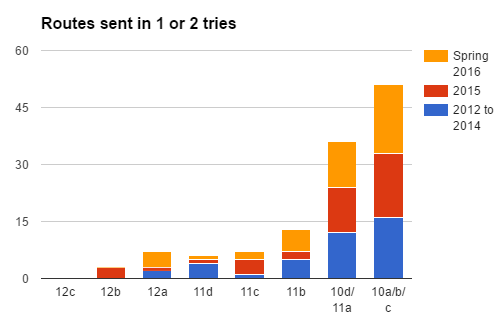
At the start of the season I decided I wanted to prioritize getting outside whenever possible, while also making progress on my long term training goals.  This slowed my training cycles down a bit, but it meant that I climbed outside on 25 days at the Red and New between January and May.  The days at the Red included two days of easy trad, a day of hiking cliffs, and another replacing bolts.  I also climbed 7 days straight during spring break, so not all days were optimal sending conditions.  Correspondingly I climbed a high volume of routes between 10a and 11b.  

The punchline of the above chart is that I climbed a years worth of routes in a single season.  This is a result of both climbing more days, but also climbing more 10a+ routes in each day. Both of these are due to the great improvements in my approach to training following the publication of the RCTM in March of 2014. Prior to the Anderson brothers' book I had no idea how I would return to the climbing fitness I enjoyed in my 20's. I still had 5.12 skills, but I was trapped in a body with 5.8 fitness. Floundering on routes that I used to warm up on was hugely demotivating, and figuring out how to return to a process of improving has invigorated my desire to climb and spurred me to improve my general fitness. What is not visible in the chart above is the joy I feel at age 45 from regaining the capacity to climb well on the routes that inspire me.  


Enjoying my climbing again while warming up on Johnny B Good

Below are some photos with highlights from spring season 2016.My first trip to the Red was on February 28th, during the first week of my hangboard cycle.  I was happy to onsight Amarillo Sunset despite neglecting endurance all winter.  Here is Yoichi getting ready to clean the draws on TR.  


One of my early highlights was onsighting 8133 (a cool 11d at the Portal).  8133 is a steep jughaul that starts with a tricky boulder problem.  I was psyched to send this in early March, and well before my performance season.

Steep.

 
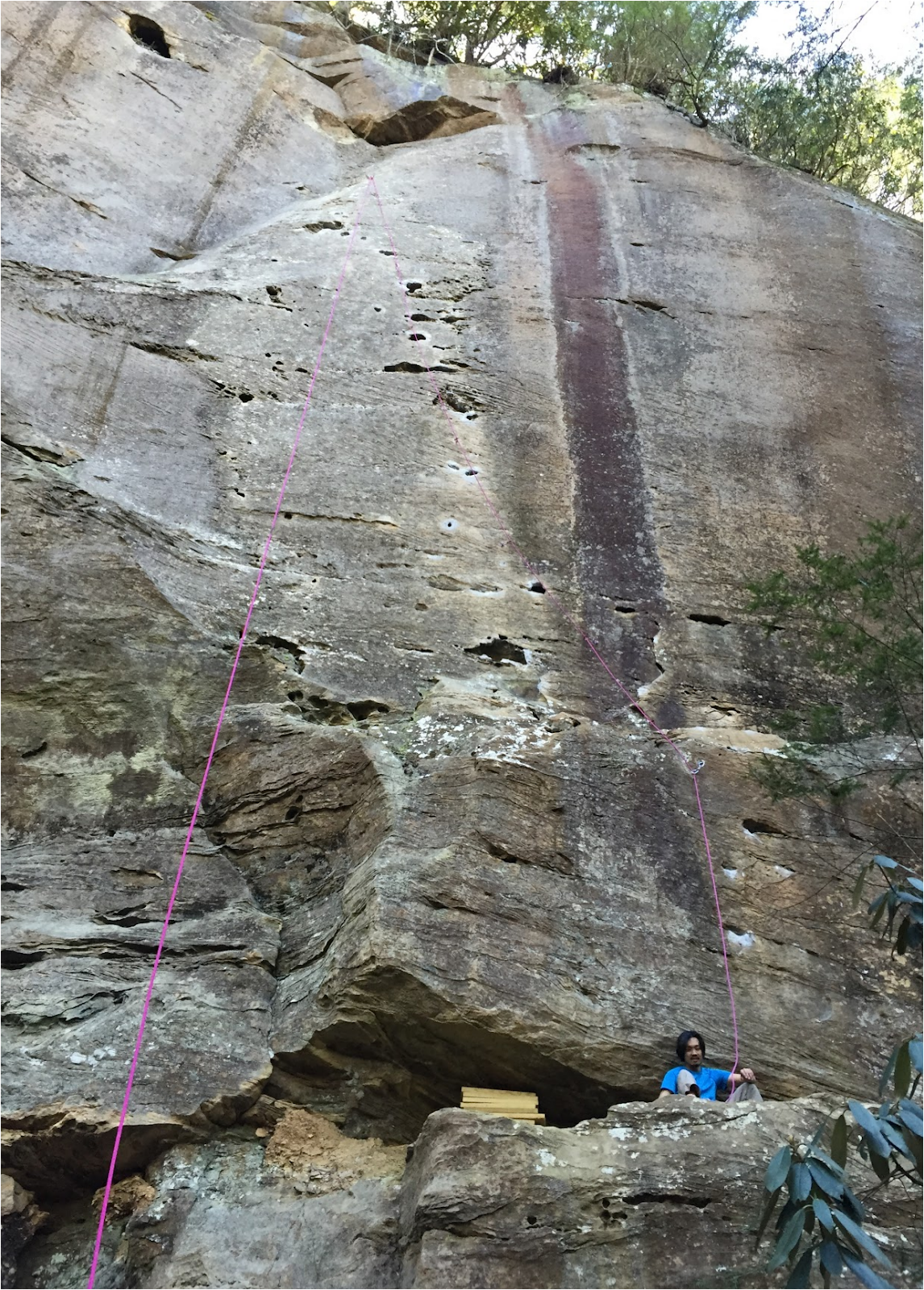
Diablo is the perfect sport route.  The crux is at the top. It is a clear line on a smooth sweeping wall that gets increasingly steep the entire way.   The route is 75 feet with just 6 bolts, and although the last couple runs are spacious, the falls are clean and fun.  


The crux is on smaller pockets at the end, and it can be hard to onsight because it is not clear which pockets are good and which are bad. You just have to commit to a sequence and roll the dice.  Unlike many RRG routes of similar grade and angle there are no easy rests.  No: kneebars, ledges, calf hooks or coffin rests.  This makes the route a cool test of your deep hold endurance because you have to avoid getting pumped in the 70 feet of big move steep climbing leading to the powerful concluding moves.  

slab.PNG

I fell off my flash attempt while grabbing the final hold.  I returned a couple weeks later and sent it next go.  


Early in the season, while bouldering on the Moonboard I tweaked the collateral ligaments in my A2 knuckle of my left index finger just as my power cycle was supposed to start.  This forced a reassessment of my season plans, and so I lowered the intensity of limit bouldering and campusing effort for the whole season.  I took it easy generally in terms of power training, and correspondingly, my power really felt lower this season.  This also meant that my outdoor climbing days tended to include fewer hard routes and fewer routes with bouldery sections.  On the bright side, that included a couple of great trad climbing days.


Not everything was a success.  I narrowly missed flashing Way Up Yonder, and more narrowly missed sending it on my second try a week later.


I got on several 12b’s this season, and got shut down by power moves.  They just felt out of reach in terms of both finger strength and in my capacity to pull off more extreme moves.  This was frustrating in the moment, but as I look back on the actual training that I have been able to do, this ebb in power was completely predictable given my limited ability to invest in the necessary training this season.  Even so, I continued to benefit from the progress in endurance, strength and power endurance all of which are better than they were in the fall.  Plus, I sent at a decently high level from March to May, including sending Betavule Pipeline (12a) on my final trip of the season.

I think the two best insights from my season follow from my growing capacity to enjoyably climb the types of routes that I want to climb as well as my awareness of how to keep training in order to improve into my coming years.  I turned 45 in May and I can see plenty of room to keep improving over the next 5 years, and I think my long term enjoyment of this activity will stem from the progress I am able to make during this time period.

So, I am really thankful for Mark’s ongoing efforts to help others improve and to develop the self awareness to guide their own progress for years to come.  I am glad to contribute in my own local community by helping other climbers reflect on their own climbing/training/goals and to move forward using insights from the RCTM.  Several of my friends have set new benchmarks this spring, and I know that this all stems from the work set into motion by the Andersons.  We all can achieve more now because we are standing on the shoulders of giants, and I am glad for the chance to be part of that process.


(Yoichi climbs with confidence on AWOL)


One for the future. 

Monday, April 11, 2016

Almost there


almost. . .

Wednesday, March 23, 2016

Training works!


None of this would be possible without the RCTM hangboard training and the Forge!